死神来了
Chinese scientists develop electrode coating to address signal loss and tissue adhesion problems in long-term brain-computer interface implantation_我的网站

A | 中新社北京8月21日电 (记者 李纯)中国国家卫生健康委员会21日在北京举行发布会,新闻发言人谢杨提示公众,发现打着“宗教医学”幌子非法行医、举办所谓“道医资格证”等培训的,可向当地相关部门举报。
谢杨表示,近年来,一些不法机构和个人以“道医传承”“道医资格证”“道医师”等名义开展培训、发放证书,并宣称持证即可看病、开方,甚至借“道医”“佛医”等名义非法行医,给民众身体健康和财产安全带来风险。
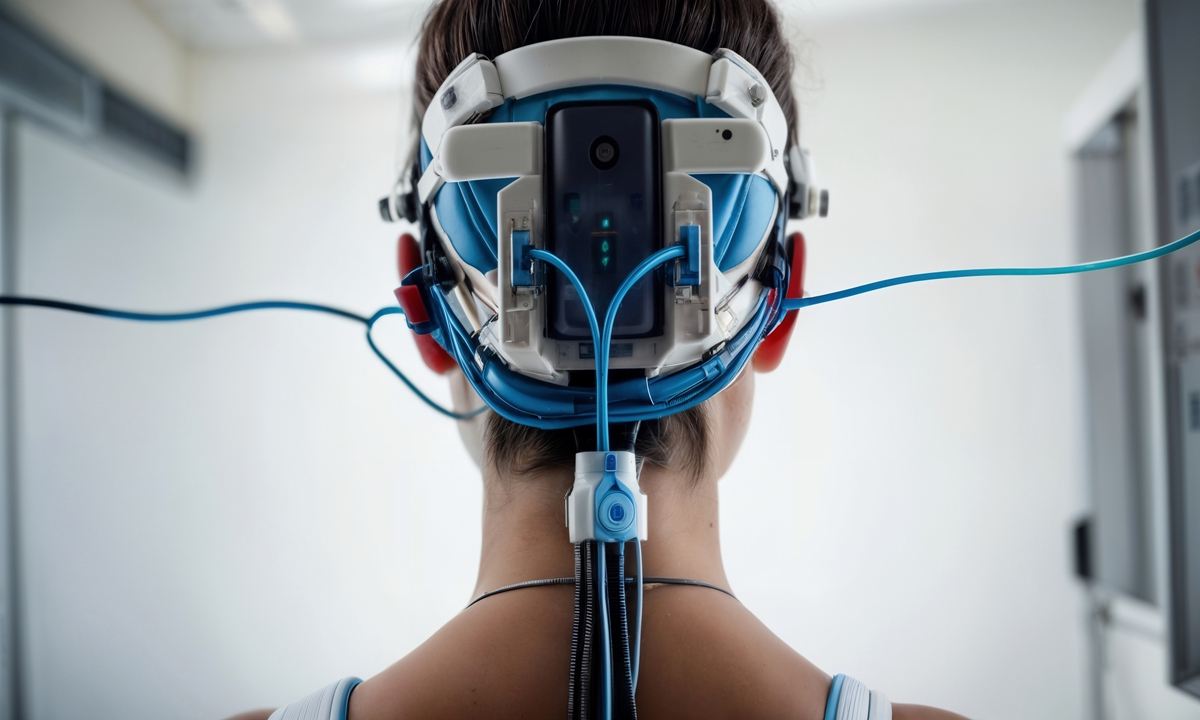
Photo: VCG
Chinese researchers have developed a multifunctional electrode coating that addresses key challenges in long-term brain-computer interface (BCI) implantation, including signal loss and tissue adhesion, bringing BCI one step closer to clinical application, the Global Times learned from the research team behind the findings on Sunday.
As an emerging field combining neuroscience and artificial intelligence (AI), BCI faces a major challenge of ensuring long-term compatibility between electrodes and brain tissue. Previous clinical trials showed that immune responses could cause implanted electrodes to retract after just three months, severely reducing signal quality and the number of available channels.
This problem stems from chronic inflammation triggered by implants, which creates insulating scar tissue around electrodes and separates them from neurons. Irreversible adhesion between electrodes and brain tissue after long-term implantation also makes device removal risky, potentially causing brain injury during follow-up surgeries.
Experiments showed that flexible neural electrodes coated with this material could operate stably in the brain for more than 300 days and could be safely removed without causing damage. This means the universal coating technology can make electrodes not only operate stably over the long term but can also be safely removed and replaced after aging, paving the way for long-term BCI applications.
Developed by the research team led by Zhang Wei at the Technical Institute of Physics and Chemistry, Chinese Academy of Sciences, associated with Beijing Tiantan Hospital, Shanghai Institute of Microsystem and Information Technology and NeuroXess, a high-tech life science company specializing in BCI technologies, the cationic alternating peptide electrode coating preserves electrode flexibility and conductivity, while offering antibacterial, anti-protein adsorption and immune-rejection-inhibiting functions.
A 300-day animal study showed the coating's effectiveness. Bare electrodes experienced a sharp loss of recording capability after 90 days of implantation and could barely detect neuronal signals after 300 days. In contrast, coated electrodes maintained stable recording channels and consistently captured neural signals above 155 microvolts.
In terms of neural modulation, after 300 days of implantation, conventional electrodes required a current of 100 microamps to induce weak limb responses, while coated electrodes triggered clear movements with only 2 microamps, improving modulation efficiency by 50 times.
Notably, the removal tests highlighted a key advantage of the coating that electrodes no longer form irreversible bonds with brain tissue. In the experiments, the coated electrodes were removed intact, with minimal damage to the surrounding brain tissue, Zhang told the Global Times on Sunday.
。
谢杨说,国家卫健委提示,从事疾病诊断、治疗活动,应当依法取得相应执业资格,并在依法设立的医疗机构内开展。以“道医”“佛医”等名义开展诊疗、开具处方、销售药品等活动,涉嫌非法行医。
谢杨还指出,发现打着“宗教医学”幌子非法行医、开展“伪科普”牟利、进行虚假广告宣传、开展营销活动或举办所谓“道医资格证”等培训的,可向当地公安、卫生健康、市场监管等部门举报,也可以拨打热线反映,避免上当受骗、避免健康损害。
此外,关于中国近期新冠疫情,中国疾病预防控制中心研究员王富珍在当天的发布会上介绍说,前一段时间,新冠疫情出现了周期性波动,在8月中上旬达到高峰平台期,现在已经出现下降趋势,南方下降趋势较为明显。疫情整体强度与前两年相当,疾病仍然以轻症为主,监测未发现可能引发重大公共卫生风险的变异株,也未发现疫情波动对整体医疗秩序造成明显影响。(完) 【编辑:万纪玮】。
Current article:http://yp011w7.zhuaicaisaanzhenshunnaiwei.bond/list_23fvvgp/28sq.html
Published on:17:09:16